How to Write Headlines in 2025: Complete Guide with Proven Frameworks
You have about two seconds to win a click. If your headline misses, your content won't get a chance. This guide shows you how to write headlines that earn attention, clicks, and conversions in 2025—backed by psychology, proven copywriting frameworks, and a fast end-to-end workflow you can reuse.
We'll cover what makes a good headline, the core anatomy of persuasive headlines, reliable formulas, quick persuasive techniques, channel and intent alignment, a practical 7-step process, examples, common mistakes, and a tooling pipeline to go from words to production-ready assets.
Why Headlines Matter: What Makes a Good Headline
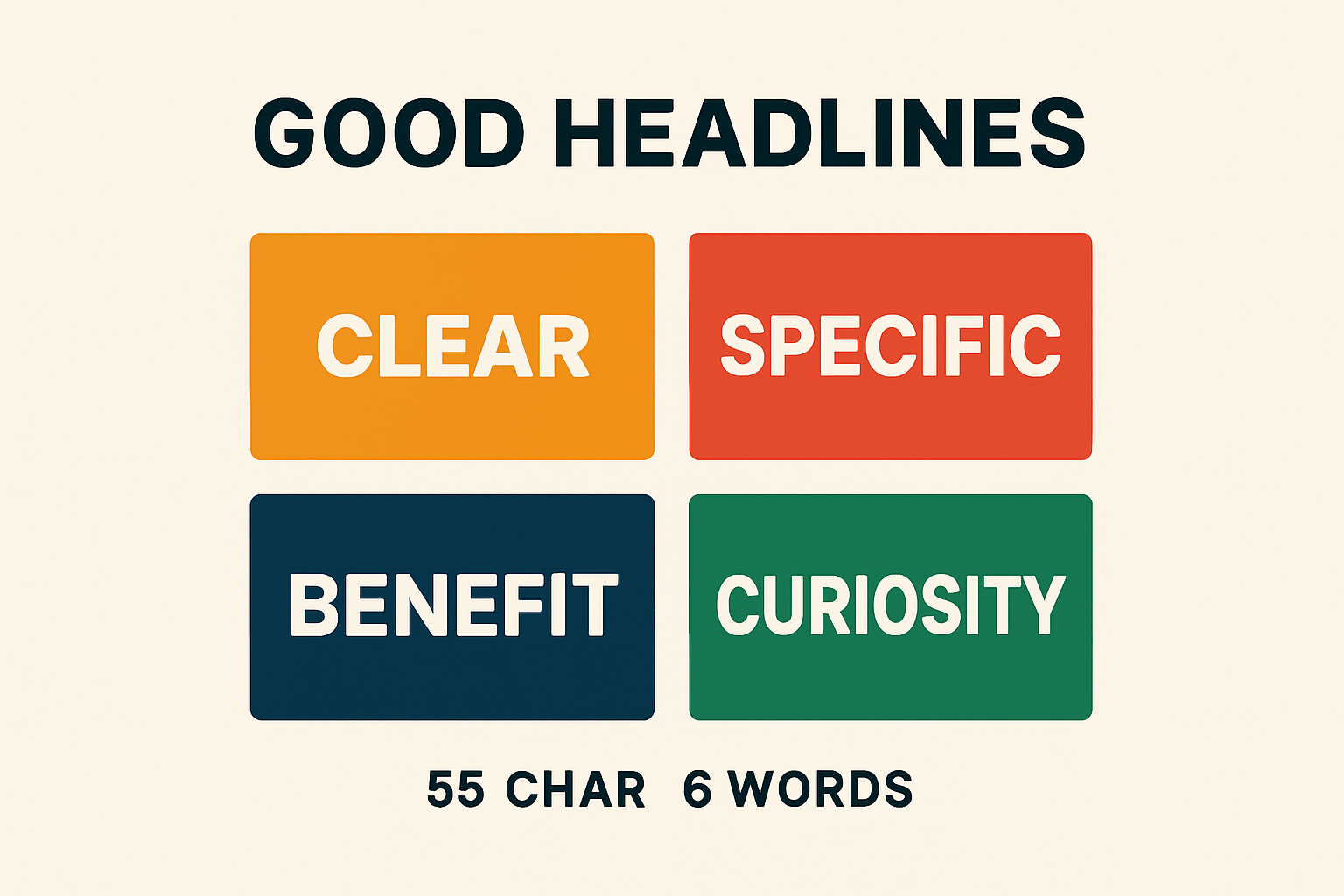
Definition: A good headline is simple, specific, and benefit-led. It clarifies value in seconds and sparks just enough curiosity to earn the next click.
- Clarity: Say the core promise plainly. According to Purdue's marketing guidance, use active voice and strong verbs for immediate comprehension.
- Relevance: Match the reader's intent and context (search, social, email, landing page).
- Benefit: Lead with an outcome that matters to the audience.
- Curiosity: Create an open loop without being vague. Research summarized by Platform Magazine notes that curiosity and actionable information increase engagement.
- Specificity: Use numbers and concrete details. The Content Marketing Institute explains that precise numbers signal order and value.
- Conciseness: Keep it short. CoSchedule data (as reported by Knowledge Enthusiast) suggests around 55 characters or ~6 words performs best—especially on mobile.
Bottom line: clarity gets the click; curiosity seals it.
The Core Anatomy of High-Performing Headlines
Use these building blocks to craft persuasive headlines consistently.
Audience and Context First
Before you write, decide who you need to move and where they'll see the headline. Searchers want clarity fast; social scrollers need intrigue; landing page visitors expect a direct value promise. This simple alignment step prevents misfires and helps you pick the right copywriting frameworks.
Problem and Promised Outcome
Surface a pain, then promise a concrete win. For example: "Stop Cart Abandonment: 5 UX Fixes You Can Ship Today." It's specific, benefit-led, and immediate—an attention grabbing headline without hype.
Mechanism and Unique Angle
What makes your approach different? Add a mechanism: "using customer journey heatmaps," "with a 3-step QA," or "via zero-party data." This creative angle sparks curiosity without being vague.
Proof and Specificity
Add numbers, timeframes, or social proof: "Cut Time-to-Value in 7 Days," "Trusted by 3,100+ founders," or "Backed by Stanford research." Numbers and details boost credibility quickly—CMI notes they provide order and signal value.
Emotion and Power Words
Layer emotional resonance with power words for headlines: "instant," "effortless," "proven," "secure," "exclusive." Positive emotional headlines tend to attract more shares, according to CoSchedule's analysis. Use them to amplify desire—never to overpromise.
Constraints: Clarity, Length, Readability
- Prefer active voice and strong verbs (Purdue).
- Keep it brief. Short titles capture attention better (CMI). Aim ~55 chars (CoSchedule).
- Design for mobile-first readers—concise, straightforward, and scannable (Knowledge Enthusiast).
Copywriting Formulas That Still Work in 2025
Use these reliable copywriting formulas to prototype headlines fast, then refine.
How-to Formula
Why it works: readers are drawn to "how to" like iron to a magnet (Pennington Creative). It's benefit-first and clear.
Pattern: How to [Win] Without [Pain] in [Timeframe]
Example: How to Cut Support Tickets 30% Without Hiring in 14 Days
Numbered List Formula
Numbers increase scannability and signal value. HubSpot's most shared posts often include a number (analysis), and listicles consistently perform well in research by Dr. Sundar (Platform Magazine).
Pattern: [Number] Ways to [Outcome] Even If [Objection]
Example: 9 Ways to Lift Checkout Conversions Even If Traffic Is Flat
Question and Curiosity Formula
Use WH-questions and open loops—effective techniques supported by HSS Comms coverage. Keep the benefit obvious.
Pattern: What If You Could [Outcome] By [Mechanism]?
Example: What If You Could Launch Faster by Reusing Your Best Copy?
Command and Action-Led Formula
Start with an imperative verb—action verbs add energy and suspense (Pennington Creative).
Pattern: Stop [Pain]. Start [Outcome] in [Timeframe].
Example: Ship Conversion-Ready Headlines in Minutes
Comparison and Versus Formula
Place options side by side and reveal the winning angle.
Pattern: [A] vs [B]: Which Gets You [Outcome] Faster?
Example: Templates vs AI: Which Ships Better Headlines Faster?
Negative Angle and Objection Flip
Use loss aversion carefully. Avoid clickbait—Platform Magazine notes that emotionally charged techniques can work, but must deliver substance (source).
Pattern: Don't [Common Mistake]. Do This to [Outcome].
Example: Don't Chase Traffic. Fix Your Headlines to Convert Existing Visitors.
Want ready-made lines for blogs, ads, and social? See our internal roundup of Blog Title and Ad Headline Generators for rapid ideation.
Persuasive Writing Techniques You Can Apply in Minutes
Layer these quick wins over your draft to upgrade clarity, credibility, and desire.
Power Words That Boost Intent and Urgency
Group power words by function so they stay purposeful:
- Benefit: proven, results, value, winning
- Speed: instant, rapid, now, in minutes
- Safety: secure, private, safe, verified
- Scarcity: limited, only, last chance
- Novelty: new, next, 2025, breakthrough
Emotional Words and Empathy Mapping
Map the audience's emotional states (frustrated, overwhelmed, ambitious, cautious) to your offer. Positive emotional headlines tend to be shared more (CoSchedule). Pair empathy with a tangible benefit: "Finally, a Faster Way to Build Pricing Pages."
Proof Mechanics: Numbers, Timeframes, and Social Proof
- Numbers: 3 steps, 14 days, 27% improvement—make them real and checkable (CMI).
- Timeframes: "in minutes," "this week," "before launch."
- Social proof: users, teams, industries (avoid unverifiable claims).
Clarity Beats Cleverness
Use the 3 S's—simple, succinct, specific—to make readers want the next line (Between the Lines Copy). Or as Leo Burnett put it, "Make it simple. Make it memorable. Make it inviting to look at. Make it fun to read." (source)
The 7-Step Process: How to Write Headlines End-to-End
At a glance (for fast reference):
- Extract value prop and audience insight
- Pick a fitting formula
- Draft 10–20 variations fast
- Add specifics, proof, and power words
- Design the visual headline
- Score, edit, and shortlist
- Ship and test

1. Extract the Value Prop and Audience Insight
Collect pains (what's broken), gains (desired outcomes), and differentiators (your mechanism). Use customer phrases verbatim to improve resonance—a core move in any AIDA or PAS workflow.
2. Pick a Fitting Formula
Match formula to intent and channel. If you need fast clarity, choose "How to." For social intrigue, use a tight question + benefit. For paid, numbers and objection flips perform well. For ideas on demand, explore our best free headline generators.
3. Draft 10–20 Variations Fast
Speed beats perfection early. Write 20 quick options to avoid anchoring bias. Swap verbs, reorder benefits, test numbers vs timeframes. Keep the best and move on.
4. Add Specifics, Proof, and Power Words
Sharpen with numbers ("in 7 days"), credibility markers ("trusted by …"), and selective power words ("instant," "safe," "proven"). Stay honest and verifiable.
5. Design the Visual Headline
Great words still need great presentation. Style for readability, contrast, and emphasis (highlights, underlines, color). A fast path is Pretty Headline—a free, browser-based editor with Google Fonts, real-time WYSIWYG, and instant exports to HTML, React, PNG, JPG, or WebP. No signup or download required. See the Getting Started guide to move from copy to polished visuals in minutes.
6. Score, Edit, and Shortlist
Rate each option on clarity, benefit, proof, emotion, and length. Trim filler, swap passive for active, and cut to ~55 characters when possible. Keep 2–4 finalists for testing.
7. Ship and Test
Publish your top variant, then A/B test headlines where possible (email subject lines, paid, social cards, hero sections). Maintain a changelog and reuse what wins.
Headline Mistakes That Kill Performance
Vagueness
No clear benefit.
Fix: add an outcome and timeframe.
Intent Mismatch
Wrong promise for the channel.
Fix: align to informational vs transactional.
Templates, Checklists, and a 5-Minute Worksheet
10 Fill-in-the-Blank Templates
- How to [Outcome] Without [Obstacle] in [Timeframe]
- [Number] [Thing] to [Outcome] Even If [Objection]
- Stop [Pain]. Start [Outcome] Today.
- What If You Could [Outcome] By [Mechanism]?
- [A] vs [B]: Which Gets You [Outcome] Faster?
- Don't [Common Mistake]. Do This to [Outcome].
- The [Audience] Guide to [Outcome] in [Timeframe]
- Steal These [Number] Headlines for [Use Case]
- Proof You Can [Outcome]: [Number] Examples That Work
- Before You [Action], Read This [Number]-Point Checklist
Headline Quality Checklist
- Clarity: Single, unmistakable promise
- Benefit: Outcome the reader wants
- Specificity: Numbers, timeframe, mechanism
- Emotion: Appropriate power words
- Length: ~55 characters or first 60 visible on mobile
- Voice: Active verbs; strong rhythm
- Fit: Matches intent and channel
- Proof: Credible, checkable, no hype
Tooling and Workflow: From Headline to Production
Design and Export with Pretty Headline
Pretty Headline is a free, lightning-fast online headline design tool for conversion-optimized hero lines and landing page headlines. Style with professional Google Fonts, add highlights/underlines/colors, and preview in real time. Export production-ready HTML, React components, or images (PNG, JPG, WebP) instantly—no signup, no downloads, fully private.
- Problem solved: speed—ship polished visual headlines in minutes instead of waiting on design cycles.
- Problem solved: consistency—typography presets and repeatable highlights keep brand feel tight.
- Problem solved: handoff friction—export code or assets that drop into your CMS or repo.
- Problem solved: mobile readability—test line breaks and contrast visually before you ship.
New to the workflow? Read Getting Started with Pretty Headline and move from draft to deploy in one session.
FAQ: Headline Fundamentals
How long should a headline be?
Aim for about 55 characters or roughly six words for mobile scannability, per guidance summarized by CoSchedule. Prioritize front-loaded benefits.
Should I always include a number?
No, but numbers often help with clarity and shares. HubSpot's top shared posts frequently feature numbers—use them when they add real value.
Is "how to" still effective in 2025?
Yes. "How to" remains a top performer because it promises actionable value fast—especially when paired with a timeframe or mechanism.
What's the best way to test headlines?
Use A/B tests in email, paid, or landing pages. Keep one variable (the headline) and measure CTR, time on page, and conversion impact.
Do emotional or positive headlines perform better?
Positive emotional headlines often get more shares; still, match tone to audience and context. Balance emotion with clarity and proof.
Next Steps and CTA
You now have a repeatable system for headline writing—from insight to formula, from variants to visual design, from scorecard to test. Put it to work on your next post, landing page, or email.
Ready to ship? Design your headline using the editor and export it as HTML, React code, PNG, JPG, or WebP.
Ready to Create Your Perfect Headline?
Design conversion-ready headlines with professional typography and export production-ready code or images in seconds. No signup required.
Try Pretty Headline Now →